Cacciuttolo
El Downtempo del Aconcagua
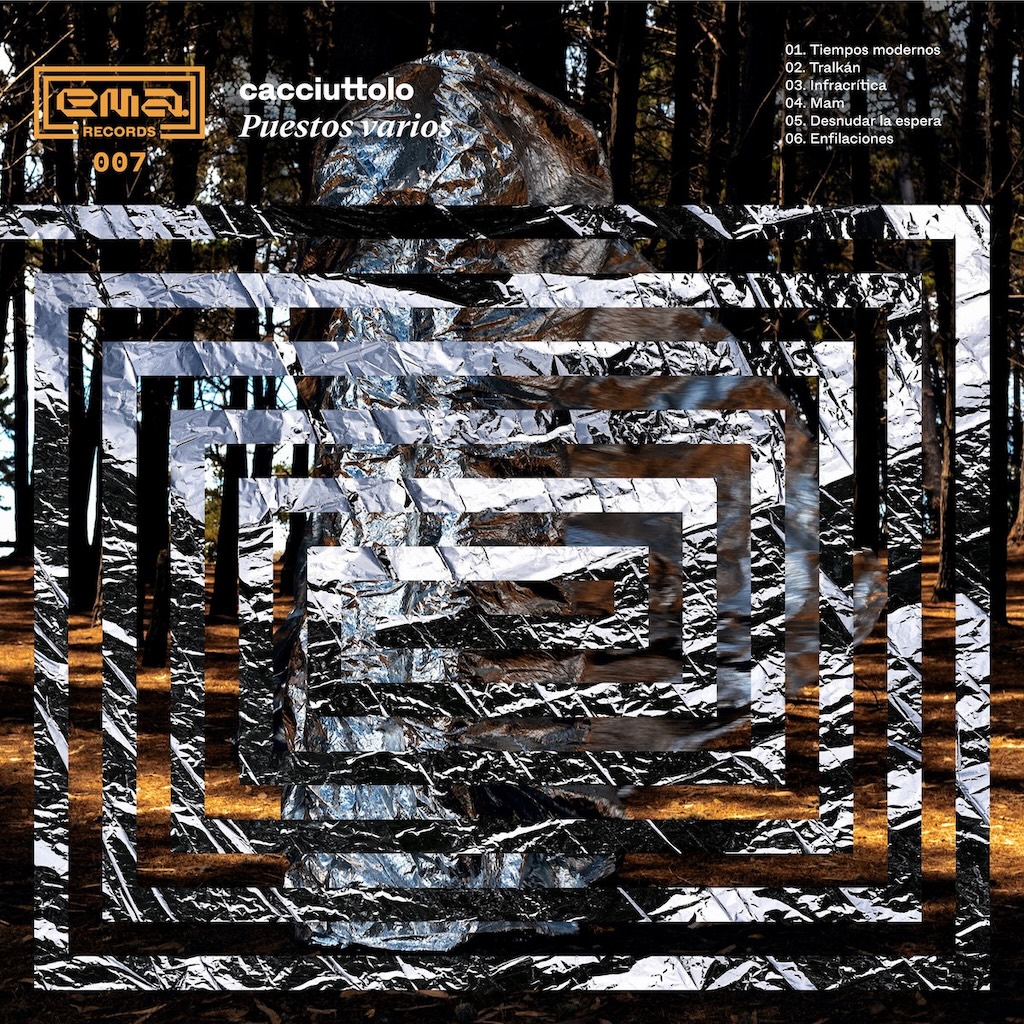
Topografía y geopoética: “Puestos Varios” (EMA Records 007) por Cacciuttolo. (2020-2022)
Existen discos que parecen surgir de una idea única y otros que se construyen lentamente a partir de materiales dispersos que terminan encontrando una forma común. A primera vista, “Puestos Varios” pertenecería a esta segunda categoría. Las seis composiciones que lo integran fueron concebidas entre 2020 y 2022 para contextos distintos: festivales audiovisuales realizados durante la pandemia, archivos patrimoniales, documentales inconclusos, compilados colectivos e improvisaciones registradas en una sola toma. Sin embargo, a medida que la escucha avanza, la aparente dispersión comienza a revelar una coherencia inesperada. Lo que une estas piezas no es una estética rígida ni un programa conceptual evidente, sino una sensibilidad que atraviesa todo el álbum y que termina otorgándole una identidad singular.
No es un detalle menor que estas obras hayan sido creadas durante los años más complejos de la pandemia. Fueron tiempos de encierro, trabajo remoto, incertidumbre y suspensión, años en que la experiencia cotidiana se replegó sobre sí misma mientras la imaginación adquiría una importancia inesperada. Aunque el disco no aborda explícitamente aquel período histórico, resulta difícil no percibir en él algo de esa temporalidad ralentizada y contemplativa. Las composiciones parecen respirar a otro ritmo, como si hubieran sido concebidas en un espacio donde el tiempo dejó de obedecer momentáneamente a las exigencias habituales de la vida contemporánea.
Pero la pandemia explica sólo una parte de la historia. Para comprender verdaderamente la música de Juan Pablo Cacciuttolo es necesario considerar también su formación como arquitecto y paisajista. Ambas disciplinas atraviesan profundamente su obra. Sus composiciones no se limitan a organizar sonidos ni a construir atmósferas; funcionan más bien como espacios habitables, como recorridos donde la percepción avanza lentamente descubriendo profundidades, perspectivas y horizontes. Por ello, la música de Cacciuttolo no es solamente contemplativa. Es, ante todo, topográfica.
La escucha se asemeja a una travesía. Cada textura abre una distancia, cada frecuencia delimita un espacio y cada silencio genera una perspectiva nueva. Sus composiciones poseen relieve, orientación y profundidad. Sin embargo, la topografía explica únicamente una dimensión de la experiencia. Existe también algo profundamente geopoético en esta obra. El paisaje no aparece aquí como una representación externa ni como una descripción del territorio. La montaña, el viento, la piedra, la luz o la amplitud del horizonte funcionan como condiciones de percepción, como sensibilidades que atraviesan la escucha y terminan modelando la experiencia desde dentro.
Quizás por ello las referencias musicales que surgen durante la escucha funcionan sólo como puntos de orientación. Ecos lejanos de Warp Records, Aphex Twin, Kruder & Dorfmeister, O Yuki Conjugate, Rapoon, Scorn o Carter Tutti aparecen ocasionalmente en el horizonte. Sin embargo, ninguna de estas asociaciones alcanza a explicar completamente la singularidad de la obra. Cacciuttolo parece tomar elementos provenientes de distintas tradiciones para conducirlos hacia otro lugar, uno más cercano al paisaje que a la escena musical, más próximo a la geografía que al género.
Porque aunque hace décadas reside en Santiago, continúa siendo, en cierto sentido, un hombre de montaña. Los Andes nunca aparecen de manera explícita en sus composiciones, pero permanecen allí de forma implícita, como una memoria atmosférica que atraviesa silenciosamente cada pieza. El frío de las alturas, la amplitud del horizonte, la mineralidad de la piedra y la presencia inmóvil de las cumbres parecen filtrarse constantemente en estas grabaciones. Quizás por eso la imagen que mejor resume el espíritu de este álbum sea también la más sencilla: una forma de downtempo cordillerano. El downtempo del Aconcagua.
La pieza que abre el disco, «Tiempos modernos», establece inmediatamente las coordenadas de este recorrido. Sofisticada, elegante y refinada, evoca aquella tradición de electrónica inteligente que encontró en Warp uno de sus principales laboratorios creativos. Existen afinidades lejanas con Aphex Twin y con la sensibilidad downtempo desarrollada por clásicos como Kruder & Dorfmeister, especialmente en la atención por el detalle, en la construcción de atmósferas y en la manera en que el ritmo es utilizado para generar profundidad antes que espectacularidad. También aparecen discretos guiños al drum and bass más atmosférico, integrados de manera orgánica dentro de la composición como una corriente subterránea que mantiene el movimiento interno de la pieza. Sin embargo, allí donde gran parte de aquella electrónica europea parecía dialogar con paisajes urbanos, Cacciuttolo desplaza esa sensibilidad hacia un horizonte más abierto, más mineral y más cercano a la cordillera que a la ciudad.
«Tralkán», registrada durante abril de 2020 para musicalizar un documental de 1979 sobre las costumbres del pueblo mapuche que nunca llegó a exhibirse, establece un diálogo particularmente conmovedor entre dos tiempos suspendidos. El archivo olvidado y la pandemia, el pasado que intenta regresar y el presente detenido, conviven aquí dentro de un mismo espacio sonoro. La música no ilustra las imágenes; las habita, las huele, permitiendo que memoria y paisaje se fundan en una misma atmósfera; sinestesia ancestral high tech.
Con «Infracrítica» aparece uno de los momentos más profundos del álbum. La pieza posee una dimensión telúrica difícil de ignorar. La escucha se asemeja a un recorrido por la precordillera chilena, donde el viento seco, la piedra, los árboles dispersos y la amplitud del paisaje terminan transformándose en sonido. Por momentos surgen resonancias que recuerdan ciertos trabajos de O Yuki Conjugate o Rapoon, proyectos que lograron incorporar al lenguaje electrónico una percepción casi física de la tierra. Hay músicas que parecen construidas en estudios y otras que conservan el pulso de las ciudades donde fueron concebidas; la de Cacciuttolo, en cambio, produce la sensación de haber sido construida directamente sobre el suelo.
Pero «Infracrítica» no sólo remite al paisaje exterior. Existe en ella una cualidad profundamente introspectiva, incluso ligeramente claustrofóbica, aunque no en un sentido negativo. Se trata de una sensación más cercana a Tarkovsky que a la asfixia. La pieza invita a mirar hacia adentro, a escuchar aquello que normalmente permanece oculto bajo el ruido cotidiano. En ese movimiento hacia la interioridad aparece otra de las virtudes fundamentales de la obra: la artesanía. Una artesanía que difiere de cualquier pretensión. Nada necesita demostrar su importancia ni exhibir complejidad técnica. La música avanza con la serenidad de quien conoce profundamente su oficio y no necesita exhibirlo.
«Mam» ocupa un lugar singular dentro del recorrido. Funciona como un interludio, un umbral entre dos movimientos del álbum. Una frecuencia persistente permanece suspendida en el aire mientras los pájaros continúan cantando y el viento sigue recorriendo el paisaje. La sensación es extrañamente posthumana. Como si el último vestigio de la humanidad hubiera quedado reducido a un simple zumbido tecnológico mientras la naturaleza recupera silenciosamente el protagonismo que nunca dejó de pertenecerle. Los pájaros vuelven a ocupar el cielo, el viento retoma sus recorridos y la tierra continúa desarrollando sus ciclos. Nosotros, en cambio, parecemos haber desaparecido. Lo único que queda es una frecuencia.
La penúltima pieza, «Desnudar la espera», introduce una energía diferente. Intrépida, sensual y discretamente atrevida, activa una respuesta física inmediata. La cabeza comienza a moverse, los ojos se cierran y el cuerpo sigue el ritmo antes que la razón. Por momentos aparecen resonancias que recuerdan la elegancia austera de Scorn y la sensibilidad desarrollada por ese genio galés del bajo y la saturación: Mick Harris. No desde la imitación, sino desde una actitud compartida frente al sonido: la capacidad de construir profundidad sin grandilocuencia y sofisticación sin ostentación. La pieza parece contener mucho más de lo que declara, desplegando una riqueza interna que se revela lentamente a quien permanece escuchando.
Finalmente, «Enfilaciones» ofrece una despedida perfecta. Delicada, elegante y abierta, recuerda ocasionalmente ciertas atmósferas desarrolladas por Carter Tutti, aunque más como una afinidad de espíritu que como una referencia directa. La pieza deja una puerta abierta y se aleja lentamente en lugar de concluir de manera abrupta. Mientras las últimas resonancias desaparecen resulta inevitable imaginar una tarde observada desde las alturas, con el sol rojo descendiendo detrás de la cordillera de los Andes, las últimas luces sobre las cumbres y el océano aguardando a lo lejos. No hay nostalgia ni dramatismo en esa imagen, sino una forma serena de contemplación, como si la música comprendiera que toda despedida auténtica consiste menos en cerrar una experiencia que en dejarla continuar más allá de nosotros.
Cuando finalmente llega el silencio, permanece la sensación de haber recorrido una geografía imaginaria donde memoria, paisaje, tecnología e imaginación conviven en un equilibrio poco frecuente. “Puestos Varios” no se escucha como una colección de piezas electrónicas, sino como una obra topográfica y geopoética que transforma el sonido en territorio y la escucha en una forma de viaje. Algunas obras concluyen cuando termina la última pista; otras, como ésta, continúan resonando mucho después de haber desaparecido del horizonte.
The Downtempo of Aconcagua
Topography and Geopoetics in ‘Puestos Varios’ by Cacciuttolo.
There are albums that seem to emerge from a single idea and others that are slowly built from disparate materials that eventually find a common form. At first glance, ‘Puestos Varios’ would belong to this second category. The six compositions that comprise it were conceived between 2020 and 2022 for different contexts: audiovisual festivals held during the pandemic, heritage archives, unfinished documentaries, collective compilations, and improvisations recorded in a single take. However, as the listening progresses, the apparent dispersion begins to reveal an unexpected coherence. What unites these pieces is not a rigid aesthetic or an obvious conceptual program, but a sensibility that permeates the entire album and ultimately grants it a singular identity.
It is no small detail that these works were created during the most challenging years of the pandemic. These were times of confinement, remote work, uncertainty, and suspension—years in which daily life retreated into itself while imagination acquired unexpected importance. Although the album doesn’t explicitly address that historical period, it’s difficult not to perceive something of that slowed-down, contemplative temporality within it. The compositions seem to breathe at a different rhythm, as if they had been conceived in a space where time momentarily ceased to obey the usual demands of contemporary life.
But the pandemic only explains part of the story. To truly understand Juan Pablo Cacciuttolo’s music, it’s also necessary to consider his training as an architect and landscape designer. Both disciplines deeply permeate his work. His compositions don’t simply organize sounds or construct atmospheres; rather, they function as habitable spaces, as journeys where perception slowly advances, discovering depths, perspectives, and horizons. Therefore, Cacciuttolo’s music is not merely contemplative. It is, above all, topographical.
Listening to it is akin to a journey. Each texture opens a distance, each frequency defines a space, and each silence generates a new perspective. His compositions possess relief, orientation, and depth. However, topography only explains one dimension of the experience. There is also something profoundly geopoetic in this work. The landscape does not appear here as an external representation or as a description of the territory. The mountain, the wind, the stone, the light, or the vastness of the horizon function as conditions of perception, as sensibilities that permeate the listening experience and ultimately shape it from within.
Perhaps this is why the musical references that arise during the listening function only as points of reference. Distant echoes of Warp Records, Aphex Twin, Kruder & Dorfmeister, O Yuki Conjugate, Rapoon, Scorn, or Carter Tutti occasionally appear on the horizon. However, none of these associations fully explains the singularity of the work. Cacciuttolo seems to take elements from different traditions and lead them to another place, one closer to the landscape than to the music scene, closer to geography than to genre.
Because although he has lived in Santiago for decades, he remains, in a sense, a mountain man. The Andes never appear explicitly in his compositions, but they remain there implicitly, like an atmospheric memory that silently permeates each piece. The cold of the heights, the vastness of the horizon, the minerality of the stone, and the motionless presence of the peaks seem to constantly filter into these recordings. Perhaps that’s why the image that best summarizes the spirit of this album is also the simplest: a form of mountain downtempo. The downtempo of Aconcagua.
The opening track, ‘Tiempos modernos,’ immediately establishes the coordinates of this journey. Sophisticated, elegant, and refined, it evokes that tradition of intelligent electronica that found one of its main creative laboratories in Warp. There are distant affinities with Aphex Twin and with the downtempo sensibility developed by classics like Kruder & Dorfmeister, especially in the attention to detail, the construction of atmospheres, and the way in which rhythm is used to generate depth rather than spectacle. There are also subtle nods to more atmospheric drum and bass, organically integrated into the composition like an undercurrent that maintains the piece’s internal movement. However, where much of that European electronic music seemed to engage with urban landscapes, Cacciuttolo shifts that sensibility towards a more open, mineral horizon, closer to the mountains than to the city.
‘Tralkán,’ recorded in April 2020 to provide the soundtrack for a 1979 documentary about the customs of the Mapuche people that was never screened, establishes a particularly moving dialogue between two suspended times. The forgotten archive and the pandemic, the past that tries to return and the suspended present, coexist here within the same sonic space. The music doesn’t illustrate the images; it inhabits them, smells them, allowing memory and landscape to merge into a single atmosphere; an ancestral high-tech synesthesia.
With ‘Infracrítica,’ one of the album’s most profound moments emerges. The piece possesses a telluric dimension that is difficult to ignore. Listening to it is like a journey through the Chilean foothills, where the dry wind, the stone, the scattered trees, and the vastness of the landscape ultimately transform into sound. At times, resonances arise that recall certain works by O Yuki Conjugate or Rapoon, projects that managed to incorporate an almost physical perception of the earth into the electronic language. Some music seems to have been created in studios, while other pieces retain the pulse of the cities where they were conceived; Cacciuttolo’s music, on the other hand, evokes the feeling of having been built directly on the ground.
But ‘Infracritica’ doesn’t only allude to the external landscape. It possesses a profoundly introspective, even slightly claustrophobic, quality, though not in a negative sense. It’s a feeling closer to Tarkovsky than to suffocation. The piece invites us to look inward, to listen to what normally remains hidden beneath the everyday noise. In this movement toward interiority, another of the work’s fundamental virtues emerges: craftsmanship. A craftsmanship that defies any pretension. Nothing needs to prove its importance or display technical complexity. The music unfolds with the serenity of someone who deeply understands their craft and has no need to show it off.
‘Mam’ occupies a unique place within the album. It functions as an interlude, a threshold between two movements. A persistent frequency hangs suspended in the air as the birds continue to sing and the wind sweeps across the landscape. The feeling is strangely posthuman. As if the last vestige of humanity has been reduced to a mere technological hum while nature silently reclaims the prominence that never truly belonged to it. The birds return to the sky, the wind resumes its journeys, and the earth continues its cycles. We, on the other hand, seem to have vanished. All that remains is a frequency.
The penultimate piece, ‘Desnudar la espera,’ introduces a different energy. Intrepid, sensual, and subtly daring, it triggers an immediate physical response. The head begins to bob, the eyes close, and the body moves to the rhythm before reason. At times, resonances emerge that recall the austere elegance of Scorn and the sensitivity developed by that Welsh genius of bass and saturation: Mick Harris. Not through imitation, but through a shared attitude toward sound: the ability to build depth without grandiloquence and sophistication without ostentation. The piece seems to contain much more than it declares, unfolding an inner richness that slowly reveals itself to the listener.
Finally, ‘Enfilaciones’ offers a perfect farewell. Delicate, elegant, and open, it occasionally recalls certain atmospheres developed by Carter Tutti, though more as an affinity of spirit than a direct reference. The piece leaves a door open and fades slowly rather than concluding abruptly. As the last resonances disappear, it’s impossible not to imagine an afternoon observed from the heights, with the red sun descending behind the Andes Mountains, the last light on the peaks, and the ocean waiting in the distance. There is no nostalgia or drama in that image, but rather a serene form of contemplation, as if the music understood that every authentic farewell consists less in closing an experience than in letting it continue beyond us.
When silence finally falls, the feeling remains of having traversed an imaginary geography where memory, landscape, technology, and imagination coexist in a rare equilibrium. “Puestos Varios” doesn’t sound like a collection of electronic pieces, but rather like a topographical and geopoetic work that transforms sound into territory and listening into a form of journey. Some works conclude when the last track ends; others, like this one, continue to resonate long after they have disappeared from the horizon.