In Memoriam Gilles Deleuze – Mille Plateaux (1996)
Música y pensamiento
Este próximo 4 de noviembre se cumplen 31 años de la muerte de Gilles Deleuze, fallecido en París el 4 de noviembre de 1995. Fue uno de los pensadores franceses fundamentales de la segunda mitad del siglo XX y su obra desbordó ampliamente los límites de la filosofía para internarse en la literatura, el cine, la pintura, la estética y, como veremos aquí, también la música.
Recuerdo perfectamente aquella época. Yo era bastante joven y Background, nuestra tienda, llevaba apenas un par de años funcionando. No recuerdo exactamente cómo me enteré de la muerte de Deleuze; probablemente la noticia circuló entre nosotros, en aquellas conversaciones interminables que se daban en la tienda. Estaban allí amigos como Andrés Guzmán Heim, Hugo Chávez Smith, Miguel Araneda, mi colega en Loop Guillermo Escudero, entre otros habituales de Background. Como me ocurriría después con la muerte de William S. Burroughs, la noticia quedó para siempre asociada a aquel lugar extraordinario de los años noventa donde discos, libros, conversaciones y personas parecían cruzarse constantemente.
La verdad es que entonces yo sabía muy poco de Gilles Deleuze. Lo estudiaría mucho después, ya bastante mayor, en la universidad. Mi entrada a Deleuze ocurrió de una manera mucho más extraña: primero llegó la música y después llegó la filosofía.
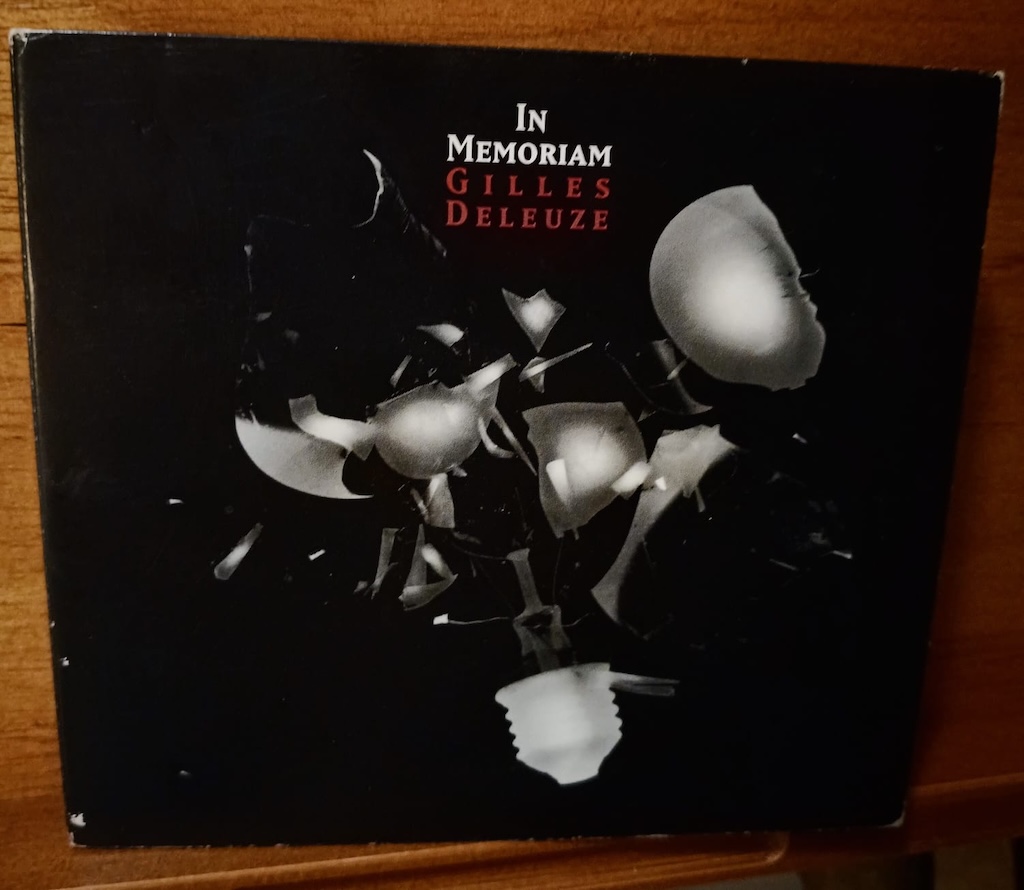
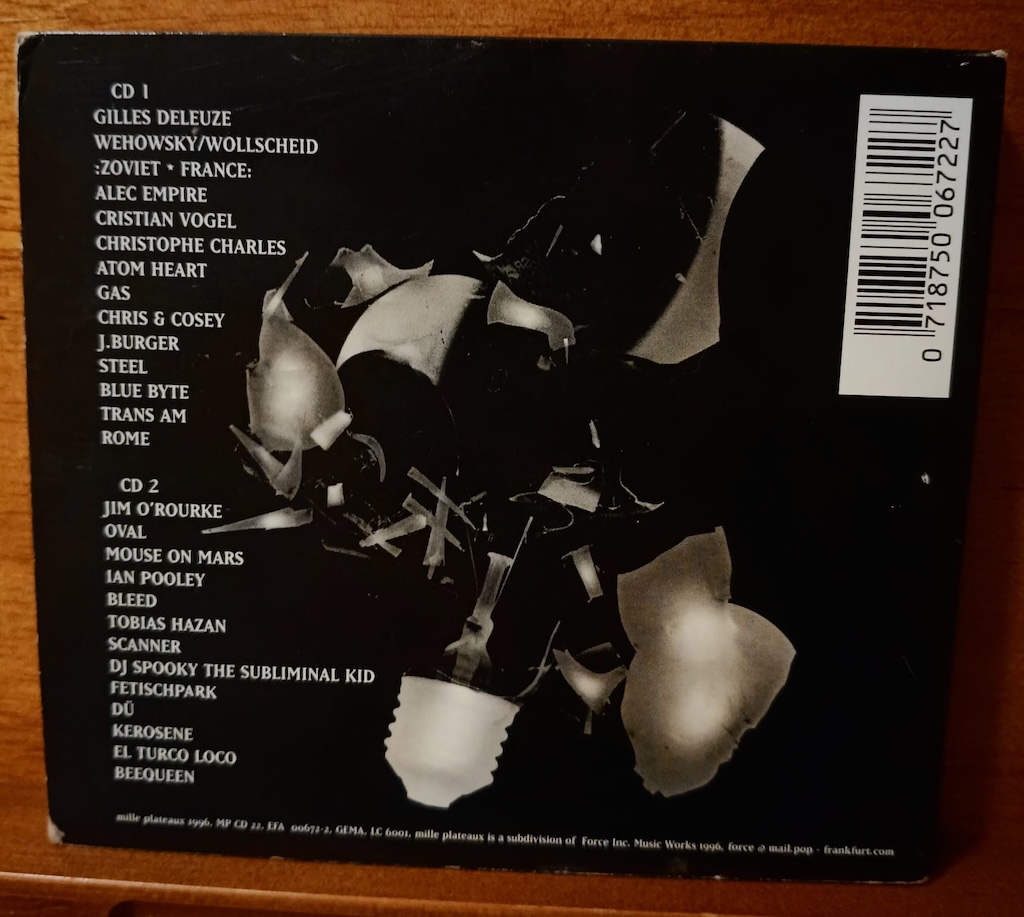
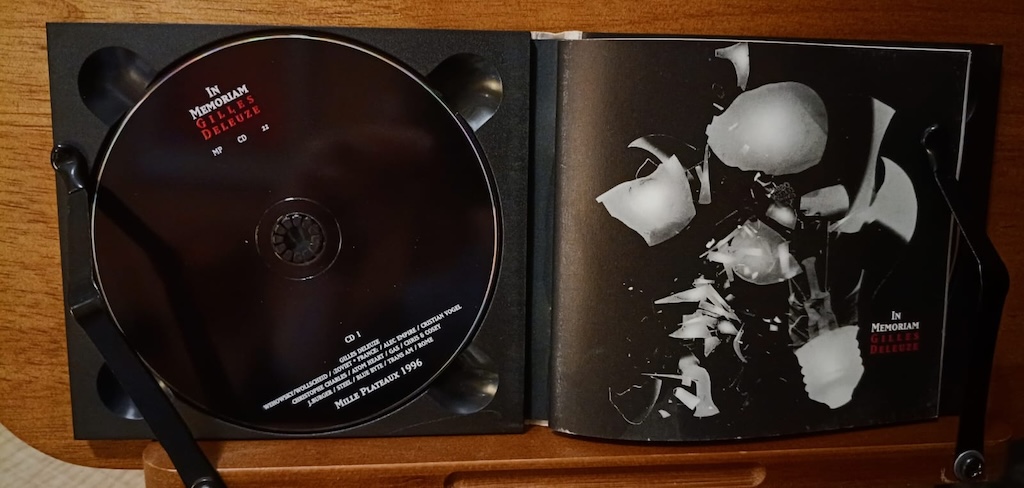
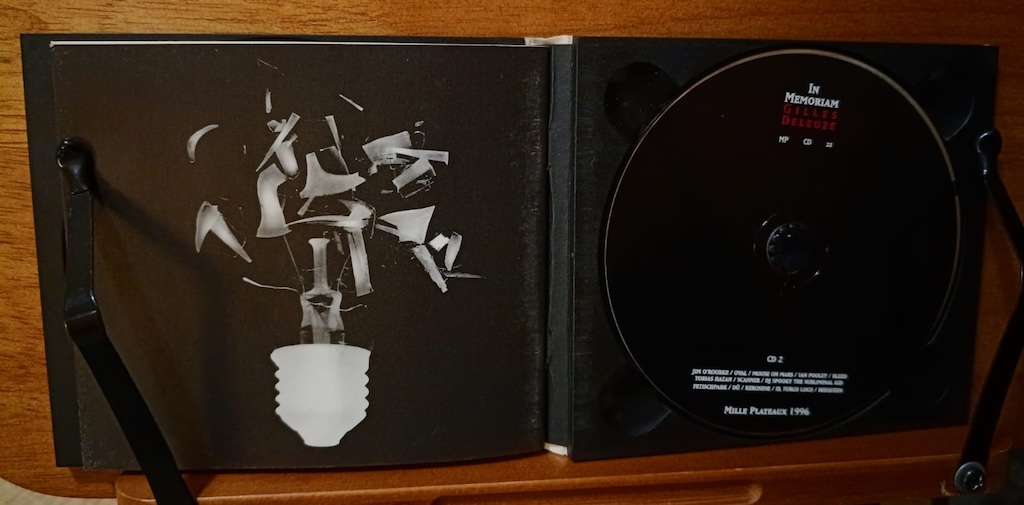
En 1996 apareció In Memoriam Gilles Deleuze, editado por el sello alemán Mille Plateaux, un doble CD de 27 piezas que todavía conservo en su edición original, comprado en Background el mismo año en que salió.
Y aquí hay un dato fundamental: Mille Plateaux toma directamente su nombre de Mille plateaux, Mil mesetas, la obra escrita por Gilles Deleuze y Félix Guattari. No estamos, por lo tanto, ante un sello que circunstancialmente decidió homenajear a Deleuze después de su muerte. La relación estaba inscrita desde el propio nombre del sello. Achim Szepanski había llevado aquellas ideas al terreno de la electrónica, entendiendo Mille Plateaux no solamente como una compañía discográfica, sino como una plataforma atravesada por conceptos como desterritorialización, rizoma, nomadismo, máquina, multiplicidad y devenir.
Con los años fui descubriendo hasta qué punto la importancia de Deleuze excedía la filosofía. Lo hemos encontrado varias veces en revisiones anteriores: al hablar de Graeme Revell y SPK, al internarnos en Nick Land, la hiperstición y el Numogram, e incluso al establecer ciertas relaciones —sin pretender que sean sistemas equivalentes— con modelos como el I Ching o determinadas representaciones de la Cábala.
Deleuze sigue sin agotarse.
Y quizás por eso tiene sentido volver hoy a aquel disco.
LA HIERBA, EL RIZOMA Y LA MUERTE
El compilado comienza con el propio Gilles Deleuze. Son apenas unos segundos. Antes de escuchar a cualquiera de los músicos, escuchamos al filósofo hablando de dos maneras distintas de pensar.
Una adopta el modelo del árbol. Busca primero la raíz, el origen, el fundamento, y desde allí establece ramas, genealogías y jerarquías.
La otra adopta el modelo de la hierba.
Y aquí hay que decir medio, no centro. La hierba crece desde el medio. El centro todavía supondría un lugar privilegiado desde el cual ordenar lo demás. El medio, en cambio, es conexión, encuentro, cruce. Es aquello que aparece entre una cosa y otra.
Ahí encontramos ya la imagen del rizoma.
No buscar necesariamente la raíz.
Entrar por el medio.
De ahí surge también uno de los conceptos que atraviesa todo este disco: desterritorialización. Sacar algo del lugar, función o código que parecía corresponderle y permitir que establezca relaciones nuevas. Un ruido puede abandonar su condición de interferencia y convertirse en música. Una voz puede dejar de comunicar un mensaje para transformarse en textura. Una máquina puede dejar de hacer aquello para lo cual fue diseñada.
Incluso la propia muerte de Deleuze introduce una paradoja inevitable. Durante años padeció una grave enfermedad pulmonar que terminó limitándolo profundamente. En la universidad recuerdo haber discutido alguna vez la manera en que murió. No podemos explicar psicológicamente aquella decisión ni corresponde romantizarla, pero sí podemos permitirnos una hipótesis filosófica: quizás hubo allí una negativa, un rechazo a esperar pasivamente que la enfermedad consumiera por completo su existencia.
La paradoja es enorme. Un filósofo de la vida, del devenir, de las fuerzas y las potencias termina enfrentándonos directamente con la muerte.
Pero su pensamiento insiste justamente en que la vida no puede reducirse al organismo. Hay artistas y filósofos de mala salud cuyas fuerzas biológicas pueden estar debilitadas y que, sin embargo, son capaces de percibir y producir una enorme diversidad de vida. La potencia no coincide necesariamente con la fortaleza física.
El organismo desaparece.
Las conexiones continúan.
MILLE PLATEAUX: HACER SONAR EL PENSAMIENTO
En el texto que acompaña el disco, Achim Szepanski propone algo fundamental: la actualidad de Deleuze reside también en haber buscado una respuesta que escapara a la maquinaria permanente de la información.
No producir simplemente otro mensaje dentro del mismo circuito, sino crear diferencia.
Lo minoritario.
Lo que no necesita ocupar el centro.
Lo que abre una línea de fuga.
Por eso el deseo en Deleuze y Guattari no es solamente carencia: produce. Conecta cuerpos, objetos, sonidos, máquinas, signos y fuerzas. Las máquinas tampoco son únicamente aparatos tecnológicos. Una máquina puede ser un ensamblaje de elementos heterogéneos que, al entrar en relación, comienza a producir algo nuevo.
Una máquina sonora, entonces, es mucho más que un sintetizador.
Puede ser músico, sampler, ruido, cinta, memoria, cuerpo, computadora, interferencia, ritmo, error y oyente.
Tal vez por eso, mientras revisábamos estas piezas, terminamos encontrando un término que nos sirve para buena parte del disco: música circuital.
Una música que no necesariamente se desarrolla.
Circula.
Se conecta, se bifurca, vuelve sobre sí misma, desaparece y reaparece. Muchas de estas piezas parecen comenzar antes de que nosotros entremos y continuar después de que nos vamos.
Un ouroboros musical.
DISCO UNO
Después de la breve voz de Deleuze aparecen Ralf Wehowsky y Achim Wollscheid con Happy Deterritorializations. Ya el título resulta casi programático: “desterritorializaciones felices”. Una pieza fragmentaria, dadaísta, donde los sonidos parecen perder continuamente el lugar al cual deberían pertenecer. Aquí la desterritorialización deja de ser palabra y empieza a convertirse en procedimiento sonoro.
Luego llegan los legendarios : zovietfrance:, de Newcastle, con On the Edge of a Grain of Sand. La música de :zovietfrance: siempre ha tenido algo topográfico. Aquí podría perfectamente musicalizar Mil mesetas: capas, extensiones, intensidades y transformaciones lentas. Es un dark ambient a la vez alienígena y alienante.
Hay además una sonoridad que inevitablemente me lleva al theremín y a aquellas películas de ciencia ficción y terror de los años cincuenta. No sé si técnicamente hay un theremín allí; importa menos que la memoria que activa. Para quienes crecimos durante los setenta y ochenta, determinados sonidos quedaron para siempre asociados a platillos voladores, laboratorios, criaturas y mundos desconocidos.
Una geografía sin mapa.
Alec Empire entra después con Bon Voyage. La materia cambia de inmediato. Es una música más pétrea, dura, maquinal. Una máquina que golpea y obliga al oído a reorganizarse. La desterritorialización aquí no parece contemplativa: es desplazamiento brusco.
Con Cristian Vogel y Gigantic Tautological Machinery aparece nuevamente el ritmo, pero un ritmo torcido, surrealista. Hay algo que podría recordar a Nurse With Wound y, desde nuestra perspectiva actual, también ciertas regiones de Aphex Twin. Pero estamos en pleno 1995-96: mucho de este sonido todavía estaba abriendo camino. La máquina tautológica repite y repite hasta que algo comienza a fallar, y precisamente en esa falla aparece la diferencia.
Christophe Charles, con Undirections/Continuum, funciona casi como una zona de tránsito. Tiene algo de transmisión, señal capturada y música concreta. Una pieza enigmática e introspectiva, sin un desarrollo convencional, instalada entre lugares. No una dirección: un continuo.
Después llega Atom Heart, Uwe Schmidt, con Abstract Miniatures in Memoriam Gilles Deleuze. Es una pieza bastante inusual dentro de su trayectoria. La abstracción comienza lentamente a derivar hacia un ambiente exquisito, panorámico. Por momentos parece un verdadero ocaso sonoro: sonidos de atardecer, horizonte y una serenidad que contrasta con la dureza anterior.
La desterritorialización, entonces, no tiene por qué ser siempre violencia.
También puede ser deriva.
Un pequeño ocaso dentro del disco.
Con GAS, proyecto de Wolfgang Voigt, y Heller, aparece uno de los elementos fundamentales de toda esta revisión: el loop. Una repetición que parece no tener principio ni final. Entramos cuando ya está ocurriendo y salimos sin estar seguros de que haya terminado.
Es una pieza intermediaria. Una zona.
Una meseta.
Y ahí inevitablemente aparece Diferencia y repetición: volver no significa necesariamente volver a lo mismo. La repetición puede producir diferencia.
Chris & Cosey aparecen con Intro-Spektiv, en una de sus encarnaciones más espaciales, más cercanas al universo experimental de CTI que al Chris & Cosey más reconocible y rítmico. Ya en aquellos años me interesaba muchísimo esa vertiente de Chris Carter y Cosey Fanni Tutti. Había comenzado a descubrirla también a través de compilados como Out There – A Thread Through Time.
Siempre he tenido algunas reservas con la palabra “experimental”. Cuando una práctica desarrolla durante años procedimientos propios, una estética y una tradición, deja de ser simplemente ensayo y error. En estos músicos me interesa más hablar de montaje, ensamblaje, yuxtaposición: nuestro collage perpetuo.
Sonidos que antes no tenían ninguna razón para encontrarse empiezan a convivir.
Jörg Burger, acreditado como J. Burger, aparece con Wunschmaschinenpark: un “parque de máquinas deseantes”. Y recuerdo especialmente aquellos bajos. Hoy resulta relativamente habitual alcanzar determinadas profundidades, pero en aquellos años, con buenos audífonos o buenos bafles, aquello retumbaba de una manera impresionante.
La máquina no solo se comprendía.
Se sentía en el cuerpo.
Después aparece Steel con Death Is the Beginning: la muerte es el comienzo. El título inevitablemente nos devuelve al problema de Deleuze. El organismo termina, pero aquello que una vida puso en movimiento puede seguir circulando.
También nos permitió jugar con otra asociación: el Tarot. El Loco, arcano 0, puede estar antes del recorrido y también después del Mundo. Final y comienzo vuelven a tocarse. No afirmamos que Steel estuviera pensando en ello. Es nuestra asociación.
Del final regresamos al cero.
Y entonces llega uno de los grandes momentos del disco uno: Blue Byte – Can’t Be Still.
Blue Byte era Ewald Weber, relacionado con el entorno de P16.D4, lo que ayuda a entender su gusto por el montaje y la descomposición sonora.
Recuerdo escuchar este tema cuando el disco llegó a Background. Estábamos allí Guillermo Ugarte, Andrés Guzmán Heim y otros amigos y habituales de la tienda. No recuerdo quién dijo exactamente la frase, y quizás ya sea imposible reconstruirlo, pero entre nosotros quedó asociada para siempre aquella definición:
“una rumba salida del psiquiátrico.”
Es una locura exquisita.
Hay rumba, mambo, una pulsación vagamente caribeña, pero todo sometido a un montaje absurdo, torcido y surrealista. Algo muy cercano a esa capacidad de Steve Stapleton y Nurse With Wound para tomar músicas reconocibles y hacerlas atravesar una maquinaria completamente distinta.
La rumba deja de pertenecer a la rumba.
Nuevamente: desterritorialización.
Para mí, uno de los mejores temas del disco uno.
Después viene Trans Am con Starjammer, trío norteamericano surgido en Maryland. Aquí aparece un techno particularmente elegante, psicológico y relajante. Después del desquicio de Blue Byte, calma un poco las aguas.
Es una electrónica panorámica, más cercana para mí a determinados trabajos de Richard D. James que a la austeridad estructural de Autechre. Y hacia la segunda mitad aparece además una deriva de batería manual que transforma completamente la pieza. Los golpes suenan como cañonazos. Con un buen equipo da la impresión de que el baterista estuviera ahí.
La máquina se encuentra con el cuerpo.
Qué buena música se hacía en los noventa.
El primer disco cierra con Rome e Intermodal. No se trata del posterior proyecto neofolk de Luxemburgo, sino de un trío de Chicago relacionado con aquella escena donde post-rock, dub, electrónica y ambient comenzaban a mezclarse.
La palabra que mejor le queda es amorfa.
No porque no tenga estructura, sino porque la forma parece cambiar mientras la escuchamos. Es abstracta, multiforme. El propio título lo anuncia: intermodal, aquello que pasa de un modo a otro.
Después de un disco entero de desterritorializaciones, montajes y rizomas, terminamos frente a una forma que no quiere quedarse quieta.
Y con eso cierra el primer recorrido.
DISCO DOS
El segundo CD comienza con Jim O’Rourke y As In. O’Rourke nos tenía acostumbrados desde temprano a sus excentricidades sonoras y aquí no hace concesiones.
Es una pieza difícil.
No posee un desarrollo evidente ni parece conducirnos hacia ninguna resolución. Y justamente por eso resulta completamente ad hoc: seguimos desterritorializándonos.
Esa ha sido hasta aquí una de las tónicas del compilado. Muchas piezas no “llegan” a ninguna parte. Establecen una zona, una intensidad, una textura y luego desaparecen.
Después aparece Oval con You Are Here 0.9 B.
Y aquí surge una palabra propia de aquellos años: aislacionismo. Kevin Martin había utilizado aquella denominación y en 1994 apareció Ambient 4: Isolationism, compilado fundamental para ese ambient oscuro, cerrado e introspectivo.
En Oval la definición viene al hueso.
La música parece ocurrir dentro de un espacio cerrado sobre sí mismo. El error digital, la repetición y los pequeños residuos de máquina se convierten en material musical.
Esto es precisamente una música circuital.
No se desarrolla: circula.
Luego vienen los ya consagrados Mouse on Mars, dúo alemán formado por Jan St. Werner y Andi Toma, con 1001. En aquellos años todavía no poseían la reputación que alcanzarían posteriormente, pero ya estaba su sello: electrónica rítmica, juguetona, algo enajenada, aunque siempre sostenida por un beat.
Hacia el final queda casi un latido, una batería tenue al fondo.
El circuito continúa funcionando a menor intensidad.
La música de Mouse on Mars siempre ha sido muy fina. Incluso cuando se desarma, nunca pierde elegancia.
Con Ian Pooley y Vital One volvemos a otro rasgo fundamental de cierta electrónica alemana de esos años: el encuentro entre bases procedentes del house, hip hop, funk o rap y una sensibilidad electrónica más fría, abstracta, oscura y europea.
Hay mucho juego con faders, agudos que desaparecen y vuelven, ecualización utilizada como instrumento. Hay que recordar que entonces había DJs que no se limitaban a reproducir discos: tocaban la mesa.
Y ahí está la herencia del dub.
Sacar sonidos, devolverlos, utilizar eco, delay, ecualización y fader como parte de una performance. Richard D. James trabajó también muchas veces estos cruces. Autechre se dirigió hacia otra estructura. En Ian Pooley, en cambio, el cuerpo permanece.
El ritmo viaja.
Después aparece Bleed, alias de Sascha Kösch, con Patent. Otro DJ alemán haciendo música, no solamente pinchándola.
Es un tema fantasmagórico, onírico y espacial. También intermediario: sin principio claramente reconocible ni conclusión definitiva. No hay un desarrollo narrativo; la pieza circula dentro de su propio campo.
Un sueño tecnológico.
Otra música circuital.
Luego encontramos a Tobias Hazan con Qeria for Gilles Deleuze, un viejo conocido para quienes habíamos escuchado el fabuloso sello belga Sub Rosa. Hazan ya había aparecido en Chaos in Expansion, editado en 1993, con una pieza relacionada con Lontano de Ligeti.
Y aquí nos entrega algo absolutamente atómico.
Nuclear.
Aislacionista cien por ciento.
Una música profunda y postapocalíptica que hoy podría hacernos pensar retrospectivamente en determinadas regiones de Lustmord. Parece el sonido que queda después de un acontecimiento enorme, cuando ya no queda nadie para explicarlo.
Sub Rosa, por cierto, fue uno de aquellos sellos extraordinarios —como Staalplaat— que durante los noventa nos permitieron descubrir territorios completos de música que difícilmente habríamos encontrado de otra manera.
Después aparece otro conocido de la casa: Scanner, Robin Rimbaud, con Without End.
El título prácticamente define la lógica del disco.
Sin fin.
Una pieza oscura, espacial, llena de fragmentos y presencias que parecen comunicaciones arrancadas de su contexto.
Aquí podemos hablar directamente de un ouroboros musical: una música que se muerde la cola y vuelve sobre sí misma.
Without End.
Sin principio, sin clausura.
Y quizás a esta altura ya comenzamos a comprender que ese ha sido el principio estructural del disco desde el comienzo.
Luego aparece DJ Spooky That Subliminal Kid, Paul D. Miller, con Invisual Ocean. DJ Spooky fue uno de aquellos personajes que durante los noventa pertenecieron a cierta élite electrónica e intelectual: DJ, músico, sampling, hip hop, collage, teoría.
La pieza es desolada, desértica, hostil y descentrada.
Aquí Mil mesetas podría estar perfectamente musicalizado.
Una extensión enorme atravesada por acontecimientos pequeños, residuos, señales y corrientes sin un punto privilegiado desde el cual organizar la escucha.
Una meseta sonora.
Después aparece Fetisch Park con Gradation D’Humour.
Es nuevamente montaje, collage, surrealismo. Una transmisión encima de otra transmisión, sonidos que vacilan, entran y salen, mientras permanece en el fondo un ritmo exquisito y sumergido.
Lo interesante es que la estructura no parece existir de antemano.
Se va formando.
La forma aparece gracias a la acumulación y al encuentro de materiales.
Fetisch Park fue un proyecto alemán relacionado con Carla Subito y Marlon Shy, que trabajaba precisamente en las fronteras entre sonido, performance, imagen y artes visuales. Su presencia aquí resulta completamente natural.
Luego viene Dü con Straobeik, proyecto alemán relacionado con el entorno de Colonia y con F.X. Randomiz y Jan St. Werner, quien reaparece después de Mouse on Mars.
Otra base casi hip hop, llena de ruido y sonidos por momentos informes, pero sostenida por una estructura que nunca se desarma completamente.
El caos permanece conectado al ritmo.
Con Kerosene y And Line aparece una de esas piezas inclasificables que parecen incluso defectuosas. El sonido parece ir hacia atrás, plegarse sobre sí mismo.
Aquí inevitablemente pienso en Coil y Further Back and Faster.
No porque Kerosene esté necesariamente citándolo, sino por esa sensación de backwards: avanzar retrocediendo.
Debajo permanece nuevamente el pulso.
Arriba todo puede deformarse, invertirse y regresar.
La línea avanza retrocediendo.
Ya casi al final aparece El Turco Loco con The Garantor, uno de los nombres más inolvidables de aquella época.
Ahora sabemos quién estaba detrás: Can Oral, nacido en Frankfurt, hijo de padre turco y madre finlandesa, posteriormente mucho más conocido como Khan. El seudónimo quizás tenga algo biográfico, aunque no sabemos realmente de dónde surgió y es mejor no inventarlo.
La pieza es fantástica.
Al fondo aparece una melodía distante, exquisita, mientras por encima se acumulan descargas eléctricas, ruido e intervenciones violentas.
Belleza abajo.
Electricidad arriba.
Para mí, The Garantor termina siendo una de las mejores piezas de todo el compilado, especialmente por su cierre. Todo aquello que venía flotando —la melodía lejana, las descargas, la inestabilidad— parece finalmente concentrarse en un final bellísimo.
Y llegamos finalmente a Beequeen con Layered Layers.
Beequeen era un dúo neerlandés y aquí nos entrega una electrónica cristalina, refinada, cercana por momentos a aquel universo que en los noventa llamábamos intelligent techno, aunque su mundo fuera mucho más amplio.
Es una joya.
Después de todo lo atravesado —dark ambient, techno, dub, collage, ruido, hip hop deformado, aislacionismo, máquinas y transmisiones— el disco termina con capas.
Layered Layers.
Capas estratificadas.
Una encima de otra.
Nada necesita dominar completamente sobre lo demás.
Y qué mejor manera de cerrar un homenaje a Gilles Deleuze.
MÚSICA Y PENSAMIENTO
Después de escuchar nuevamente estos dos discos resulta evidente que In Memoriam Gilles Deleuze es algo mucho más interesante que un homenaje funerario a un filósofo.
No está homenajeando solamente al hombre.
Está homenajeando una forma de pensar.
Un ethos.
Eso es, para mí, lo verdaderamente revolucionario de Deleuze.
No convertir sus conceptos en una doctrina que deba repetirse correctamente, sino utilizarlos para producir movimiento. Desterritorializar. Conectar elementos heterogéneos. Desconfiar del centro. No obsesionarse siempre con encontrar la raíz.
Entrar por el medio.
Hacer rizoma.
Las 27 piezas del compilado proceden de territorios diferentes —ambient, techno, música concreta, ruido, dub, hip hop, electrónica abstracta, collage—, pero poco a poco descubrimos que la unidad no estaba en el estilo.
Estaba en la operación.
Sacar las cosas de su lugar para permitir que produzcan relaciones nuevas.
Por eso hablamos durante esta revisión de música circuital: música que en lugar de desarrollarse necesariamente de principio a fin circula, retorna, se desvía, se fragmenta, reaparece.
Un ouroboros musical.
Y es curioso que yo llegara a Deleuze precisamente así.
Cuando murió yo era bastante joven y apenas sabía quién era. Años después lo estudiaría en la universidad, pero para entonces ya había entrado en contacto con él de otra manera.
Primero llegó Background.
Después llegó el disco.
Después llegó la filosofía.
Treinta años más tarde sigo teniendo aquella edición original y sigo descubriendo cosas dentro de ella.
Quizás eso explique mejor que cualquier definición por qué Deleuze continúa vigente.
El hombre murió.
La máquina siguió funcionando.
Las conexiones continuaron multiplicándose.
Y Beequeen termina el recorrido de la única manera posible:
El disco no termina realmente. Se estratifica.
Music and Thought
This coming November 4th marks 31 years since the death of Gilles Deleuze, who passed away in Paris on November 4, 1995. He was one of the essential French thinkers of the second half of the 20th century, and his work extended well beyond the confines of philosophy, reaching into literature, cinema, painting, aesthetics, and—as we shall see here—music as well.
I remember that period perfectly. I was quite young, and Background—our shop—had only been open for a couple of years. I don’t recall exactly how I learned of Deleuze’s death; the news likely circulated among us during the endless conversations that took place in the shop. Friends such as Andrés Guzmán Heim, Hugo Chávez Smith, Miguel Araneda, and my colleague at Loop, Guillermo Escudero—among other Background regulars—were there. Much like what would happen later with the death of William S. Burroughs, the news became forever linked to that extraordinary 1990s space, where records, books, conversations, and people seemed to constantly intersect.
The truth is, I knew very little about Gilles Deleuze back then. I would study his work much later, when I was older, at university. My introduction to Deleuze happened in a far more unusual way: the music came first, and the philosophy followed.
In 1996, In Memoriam Gilles Deleuze was released by the German label Mille Plateaux—a double CD containing 27 tracks. I still own the original edition, which I purchased at Background the same year it was released.
And here is a crucial detail: Mille Plateaux takes its name directly from Mille plateaux (A Thousand Plateaus), the work written by Gilles Deleuze and Félix Guattari. This was not, therefore, a label that simply decided, by chance, to pay tribute to Deleuze after his death; the connection was embedded in the very name of the label itself. Achim Szepanski brought these ideas into the realm of electronic music, conceiving of Mille Plateaux not merely as a record label, but as a platform permeated by concepts such as deterritorialization, the rhizome, nomadism, the machine, multiplicity, and becoming.
Over the years, I have come to realize the extent to which Deleuze’s significance transcends philosophy. We have encountered him several times in previous discussions: when exploring the work of Graeme Revell and SPK, delving into Nick Land—along with the notions of hyperstition and the Numogram—and even when drawing parallels (without implying they are equivalent systems) to models like the I Ching or certain interpretations of the Kabbalah.
Deleuze remains inexhaustible.
And perhaps that is why it makes sense to revisit that record today.
GRASS, THE RHIZOME, AND DEATH
The compilation begins with Gilles Deleuze himself. It lasts only a few seconds. Before hearing any of the musicians, we hear the philosopher discussing two distinct ways of thinking.
One adopts the model of a tree: it seeks the root, the origin, the foundation, and from there establishes branches, genealogies, and hierarchies.
The other adopts the model of grass.
And here, we must speak of the «middle,» not the «center.» Grass grows from the middle. A center would still imply a privileged vantage point from which to organize everything else; the middle, by contrast, is a site of connection, encounter, and intersection. It is what emerges between one thing and another.
Here, we encounter the image of the rhizome.
Not necessarily seeking the root.
Entering through the middle.
From this also arises one of the core concepts that permeates this entire record: deterritorialization—the act of removing something from the place, function, or code to which it seemed to belong, and allowing it to forge new relationships. A noise might shed its status as mere interference and become music. A voice might cease to convey a message and transform into texture. A machine might stop performing the very task for which it was designed. Even Deleuze’s own death introduces an unavoidable paradox. For years, he suffered from a severe pulmonary illness that eventually left him profoundly limited. I recall discussing the circumstances of his death back in my university days. We cannot explain that decision in psychological terms, nor is it appropriate to romanticize it; yet, we might venture a philosophical hypothesis: perhaps it was an act of refusal—a rejection of the prospect of passively waiting for his illness to completely consume his existence.
The paradox is profound. A philosopher of life, of becoming, of forces and potencies, ends up confronting us directly with death.
Yet, his thought insists precisely on the idea that life cannot be reduced to the organism. There are artists and philosophers in poor health whose biological strength may be diminished, yet who remain capable of perceiving and generating an immense diversity of life. Potency is not necessarily synonymous with physical strength.
The organism disappears.
The connections endure.
MILLE PLATEAUX: MAKING THOUGHT RESONATE
In the text accompanying the record, Achim Szepanski proposes something fundamental: the contemporary relevance of Deleuze’s significance also lies in his search for an answer that could escape the relentless machinery of information.
Not merely producing another message within the same circuit, but creating difference.
The minoritarian.
That which does not need to occupy the center.
That which opens up a line of flight.
This is why, for Deleuze and Guattari, desire is not just a lack: it produces. It connects bodies, objects, sounds, machines, signs, and forces. Nor are machines merely technological apparatuses. A machine can be an assemblage of heterogeneous elements that, upon entering into a relationship, begin to produce something new.
A sonic machine, then, is much more than a synthesizer.
It can be a musician, a sampler, noise, tape, memory, a body, a computer, interference, rhythm, an error, or a listener.
Perhaps that is why, while reviewing these pieces, we arrived at a term that fits much of the album: circuitous music.
Music that does not necessarily develop.
It circulates.
It connects, bifurcates, loops back on itself, disappears, and reappears. Many of these pieces seem to begin before we arrive and continue after we leave.
A musical Ouroboros.
DISC ONE
Following the brief voice of Deleuze, Ralf Wehowsky and Achim Wollscheid appear with Happy Deterritorializations. The title itself is almost programmatic: “happy deterritorializations.” It is a fragmentary, Dadaist piece, in which sounds seem to continually lose the place to which they ought to belong. Here, deterritorialization ceases to be merely a word and begins to function as a sonic procedure.
Next come the legendary :zovietfrance:, from Newcastle, with On the Edge of a Grain of Sand. The music of :zovietfrance: has always possessed a topographical quality. It could easily serve as a soundtrack for A Thousand Plateaus: layers, expanses, intensities, and slow transformations. It is a form of dark ambient that is simultaneously alien and alienating. There is also a sonority that inevitably brings to mind the theremin and those science fiction and horror films of the 1950s. I don’t know if a theremin is technically present; that matters less than the memory it triggers. For those of us who grew up during the seventies and eighties, certain sounds became forever associated with flying saucers, laboratories, creatures, and unknown worlds.
A geography without a map.
Then, Alec Empire enters with Bon Voyage. The substance shifts immediately. The music becomes more stone-like, harsh, and mechanical—a machine that strikes, forcing the ear to reorganize itself. Here, deterritorialization is not contemplative; it is a sudden displacement.
With Cristian Vogel and Gigantic Tautological Machinery, rhythm reappears—but it is a twisted, surreal rhythm. There are echoes of Nurse With Wound and, from our current vantage point, certain facets of Aphex Twin. Yet, this is 1995–96: much of this sound was still breaking new ground. The tautological machine repeats and repeats until something begins to falter, and it is precisely within that failure that difference emerges.
Christophe Charles’s Undirections/Continuum functions almost like a transit zone. It carries the quality of a transmission—a captured signal—reminiscent of musique concrète. It is an enigmatic, introspective piece that eschews conventional development, existing between places. Not a direction, but a continuum.
Next comes Atom Heart—Uwe Schmidt—with Abstract Miniatures in Memoriam Gilles Deleuze. It is a rather unusual piece within his body of work. The abstraction slowly drifts toward an exquisite, panoramic atmosphere. At times, it feels like a true sonic sunset—evoking the twilight, the horizon, and a serenity that contrasts sharply with the harshness that came before.
Deterritorialization, then, need not always be violent.
It can also be a drift.
A small sunset within the album. With GAS—a project by Wolfgang Voigt—and the track Heller, one of the fundamental elements of this entire exploration emerges: the loop. It is a repetition that seems to have neither beginning nor end. We enter while it is already underway, and we leave without ever being certain that it has truly concluded.
It is an intermediary piece. A zone.
A plateau.
And here, inevitably, Difference and Repetition comes to mind: returning does not necessarily mean returning to the same thing. Repetition can produce difference.
Chris & Cosey appear with Intro-Spektiv—in one of their more atmospheric incarnations, closer to the experimental universe of CTI than to the more recognizable, rhythmic style of Chris & Cosey. Even back then, I was deeply interested in this particular facet of Chris Carter and Cosey Fanni Tutti’s work—a side I had also begun to discover through compilations like Out There – A Thread Through Time.
I have always harbored certain reservations regarding the term “experimental.” When a practice develops its own distinct procedures, aesthetics, and traditions over the course of years, it ceases to be merely a matter of trial and error. In the case of these musicians, I find it more fitting to speak in terms of montage, assemblage, and juxtaposition—our perpetual collage.
Sounds that, when faced with had no reason to encounter one another, yet they begin to coexist.
Jörg Burger—credited as J. Burger—appears with Wunschmaschinenpark: a park of desiring-machines. And I especially recall those bass frequencies. While reaching such depths is relatively common today, back then—provided you had good headphones or high-quality speakers—the sound would rumble in an truly impressive way.
The machine wasn’t just understood;
it was felt in the body.
Then comes Steel with Death Is the Beginning. The title inevitably brings us back to a Deleuzian problem: the organism may come to an end, but what a life has set in motion can continue to circulate.
It also invited another association: the Tarot. The Fool—Arcanum 0—can exist before the journey begins, as well as after the World card. The end and the beginning touch once more. We aren’t claiming that Steel had this in mind; it’s simply our own association.
From the end, we return to zero.
And then arrives one of the great moments on the first disc: Blue Byte’s Can’t Be Still.
Blue Byte was Ewald Weber, who was connected to the circle surrounding P16.D4—which helps explain his penchant for montage and sonic deconstruction.
I remember listening to this track when the record first arrived at the shop, Background. Guillermo Ugarte, Andrés Guzmán Heim, and other friends—regulars at the store—were there. I don’t recall exactly who coined the phrase—perhaps it’s impossible to reconstruct now—but it became permanently linked to the track among us:
“a rumba escaped from a psychiatric ward.”
It is an exquisite kind of madness.
There’s rumba, mambo, and a vaguely Caribbean pulse—all subjected to an absurd, twisted, and surreal montage. It’s quite similar to the way Steve Stapleton and Nurse With Wound would take recognizable music and run it through an entirely different kind of machinery.
The rumba no longer belongs to the rumba.
Once again: deterritorialization. For me, one of the best tracks on the first disc.
Next up is Trans Am with Starjammer—a North American trio that emerged from Maryland. What we have here is a particularly elegant, psychological, and soothing form of techno. After the unhinged intensity of Blue Byte, it calms the waters a bit.
It’s a panoramic style of electronic music—to my ears, closer to certain works by Richard D. James than to the structural austerity of Autechre. Toward the second half, the introduction of live, manual drumming completely transforms the piece. The drum hits land like cannon fire; with a good sound system, it feels as though the drummer is right there in the room with you.
The machine meets the body.
What great music was being made in the nineties.
The first disc concludes with Rome and Intermodal. This isn’t the later neofolk project from Luxembourg, but rather a trio from Chicago, linked to a scene where post-rock, dub, electronic music, and ambient were beginning to converge.
The best word to describe it is “amorphous.”
Not because it lacks structure, but because its form seems to shift as we listen. It is abstract, multiform. The title itself hints at this: intermodal—something that transitions from one mode to another.
After an entire disc defined by deterritorializations, montages, and rhizomes, we find ourselves face-to-face with a form that refuses to sit still.
And with that, the first journey comes to an end.
DISC TWO
The second CD opens with Jim O’Rourke’s As In. O’Rourke had long accustomed us to his sonic eccentricities, and here, he makes no concessions.
It’s a challenging piece.
It lacks a clear progression and doesn’t seem to be leading toward any resolution. And precisely for that reason, it’s entirely fitting: we continue the process of deterritorialization.
That has been one of the defining characteristics of this compilation so far. Many of the tracks don’t “arrive” anywhere. They establish a zone, an intensity, a texture—and then they vanish.
Next comes Oval with You Are Here 0.9 B. And here, a term characteristic of those years emerges: isolationism. Kevin Martin had used this label, and in 1994, Ambient 4: Isolationism was released—a seminal compilation for that dark, insular, and introspective style of ambient music.
In the case of Oval, the definition cuts to the core.
The music seems to unfold within a space that is closed off upon itself. Digital errors, repetition, and the minor detritus of machinery are transformed into musical material.
This is, quite literally, «circuit-based» music.
It does not develop; it circulates.
Then there is the now-renowned duo Mouse on Mars—a German act consisting of Jan St. Werner and Andi Toma—with their release 1001. At the time, they had yet to attain the reputation they would later achieve, but their signature style was already present: rhythmic, playful, and somewhat detached electronic music, yet always anchored by a beat.
Towards the end, all that remains is something akin to a heartbeat—a faint percussion in the background.
The circuit continues to function, albeit at a lower intensity.
The music of Mouse on Mars has always been highly refined. Even when it deconstructs itself, it never loses its elegance.
With Ian Pooley and the track Vital One, we encounter another fundamental characteristic of a certain strain of German electronic music from that era: the convergence of drawing from house, hip hop, funk, or rap, alongside a colder, more abstract, darker, and distinctly European electronic sensibility.
There is a great deal of play with faders—high frequencies that vanish and return—with equalization employed as an instrument in its own right. It is worth remembering that, back then, some DJs did not merely play records; they «played» the mixing console itself.
And therein lies the legacy of dub.
Extracting sounds, feeding them back into the mix, and utilizing echo, delay, equalization, and faders as integral components of a performance. Richard D. James frequently explored these intersections, while Autechre gravitated toward a different kind of structure. In the work of Ian Pooley, by contrast, the physical, bodily element remains.
The rhythm travels.
Then comes Bleed—an alias for Sascha Kösch—with the track Patent. Here is another German DJ who creates music, rather than simply playing it.
It is a phantasmagorical, dreamlike, and space-age piece. It also functions as an intermediary: it lacks a clearly identifiable beginning or a definitive conclusion. There is no traditional narrative progression; the piece circulates within its own self-contained field.
A technological dream.
Another form of circuit-based music.
Next, we encounter Tobias Hazan with Qeria for Gilles Deleuze—a familiar name to those of us who followed the fabulous Belgian label Sub Rosa. Hazan had previously appeared on the 1993 compilation Chaos in Expansion with a piece inspired by Ligeti’s Lontano.
And here, he delivers something absolutely atomic.
Nuclear.
One hundred percent isolationist.
A profound, post-apocalyptic sound—one that, in retrospect, might bring to mind certain works by Lustmord. It sounds like the resonance left behind after a cataclysmic event, when there is no one left to explain what happened.
Sub Rosa, incidentally, was one of those extraordinary labels—much like Staalplaat—that, throughout the nineties, allowed us to discover entire musical landscapes we likely would never have encountered otherwise.
Then appears another familiar figure: Scanner (Robin Rimbaud), with Without End.
The title effectively defines the logic of the record. Without End.
A dark, atmospheric piece, filled with fragments and presences that feel like communications torn from their original context.
One might call this a musical ouroboros—music that bites its own tail and circles back upon itself.
Without End.
No beginning, no conclusion.
And perhaps, by this point, we begin to realize that this has been the structural principle of the album all along.
Next comes DJ Spooky That Subliminal Kid—Paul D. Miller—with Invisual Ocean. In the 1990s, DJ Spooky was a prominent figure within a certain electronic and intellectual elite: a DJ and musician who navigated the realms of sampling, hip hop, collage, and theory.
The piece is desolate, desert-like, hostile, and decentered.
It could well serve as a musical accompaniment to A Thousand Plateaus.
A vast expanse traversed by minor events, remnants, signals, and currents—with no privileged vantage point from which to organize one’s listening.
A sonic plateau.
Then comes Fetisch Park with Gradation D’Humour.
Once again, we encounter montage, collage, and surrealism. Transmissions are layered upon transmissions; sounds waver, drifting in and out, while an exquisite, submerged rhythm persists in the background.
What is striking is that the structure does not seem to exist beforehand.
It takes shape as it unfolds.
Form emerges through the accumulation and convergence of materials.
Fetisch Park was a German project—associated with Carla Subito and Marlon Shy—that operated precisely at the intersections of sound, performance, imagery, and the visual arts. Their presence here feels entirely natural.
Next is Straobeik by Dü—a German project linked to the Cologne scene and to F.X. Randomiz and Jan St. Werner (who reappears here, following his work with Mouse on Mars).
Built on a foundation that leans toward hip hop, the track is filled with noise and, at times, formless sounds—yet it remains anchored by a structure that never fully disintegrates.
Chaos remains tethered to rhythm. With Kerosene and And Line, we encounter one of those unclassifiable pieces that almost seem flawed. The sound appears to move backward, folding in on itself.
Inevitably, this brings to mind Coil and Further Back and Faster.
Not necessarily because Kerosene is directly referencing it, but because of that “backwards” quality—moving forward by retreating.
Beneath it all, the pulse remains.
Above, everything can warp, invert, and return.
The line advances while moving backward.
Nearing the end, El Turco Loco appears with The Garantor—one of the most unforgettable names from that era.
We now know who was behind it: Can Oral, born in Frankfurt to a Turkish father and a Finnish mother—later much better known as Khan. The pseudonym may well have some biographical significance, though its true origin remains unknown, and it’s best not to invent one.
The track is fantastic.
In the background, a distant, exquisite melody emerges, while overhead, electric discharges, noise, and jarring interventions accumulate.
Beauty below.
Electricity above.
For me, The Garantor stands out as one of the best tracks on the entire compilation, especially for its conclusion. Everything that had been floating the distant melody, the bursts of sound, the instability—all seem to converge, finally, into a truly beautiful conclusion.
And so, we arrive at Beequeen with Layered Layers.
Beequeen was a Dutch duo; here, they offer us a crystalline, refined form of electronic music—at times reminiscent of what we called “intelligent techno” in the nineties, though their world was far broader.
It is a gem.
After everything we have traversed—dark ambient, techno, dub, collage, noise, warped hip-hop, isolationism, machinery, and transmissions—the record ends with layers.
Layered Layers.
Stratified layers.
One atop another.
Nothing needs to completely dominate the rest.
And what better way to conclude a tribute to Gilles Deleuze?
MUSIC AND THOUGHT
Upon revisiting these two records, it becomes clear that In Memoriam Gilles Deleuze is far more than a somber, funerary homage to a philosopher.
It does not merely honor the man.
It honors a way of thinking.
An ethos.
To me, this is what is truly revolutionary about Deleuze.
It is not about turning his concepts into a doctrine to be recited correctly, but rather using them to generate movement. To deterritorialize. To connect heterogeneous elements. To be wary of the center. To avoid an obsessive fixation on finding the root.
To enter from the middle.
To form a rhizome.
The 27 tracks on this compilation emerge from diverse territories—ambient, techno, musique concrète, noise, dub, hip-hop, abstract electronics, collage—yet we gradually discover that their unity does not lie in style.
It lies in the operation itself.
Taking things out of their established places to allow for the creation of new relationships.
This is why, throughout this review, we have spoken of “circuital” music: music that, rather than unfolding in a strictly linear fashion from beginning to end, circulates, returns, deviates, fragments, and reappears. A musical Ouroboros.
And it is curious that I came to Deleuze in precisely this way.
When he died, I was quite young and barely knew who he was. Years later, I would study him at university, but by then I had already encountered him in a different way.
First came Background.
Then came the record.
Then came the philosophy.
Thirty years later, I still have that original edition, and I continue to discover things within it.
Perhaps that explains, better than any definition, why Deleuze remains relevant.
The man died.
The machine kept running.
The connections continued to multiply.
And Beequeen concludes the journey in the only possible way:
The record does not truly end. It becomes stratified.